
Get a free site visitWhatsApp us
Most estimates of a 1 MW solar plant’s income per month assume every unit is sold. On a factory roof with an HT connection, the income is the electricity bill you stop paying.
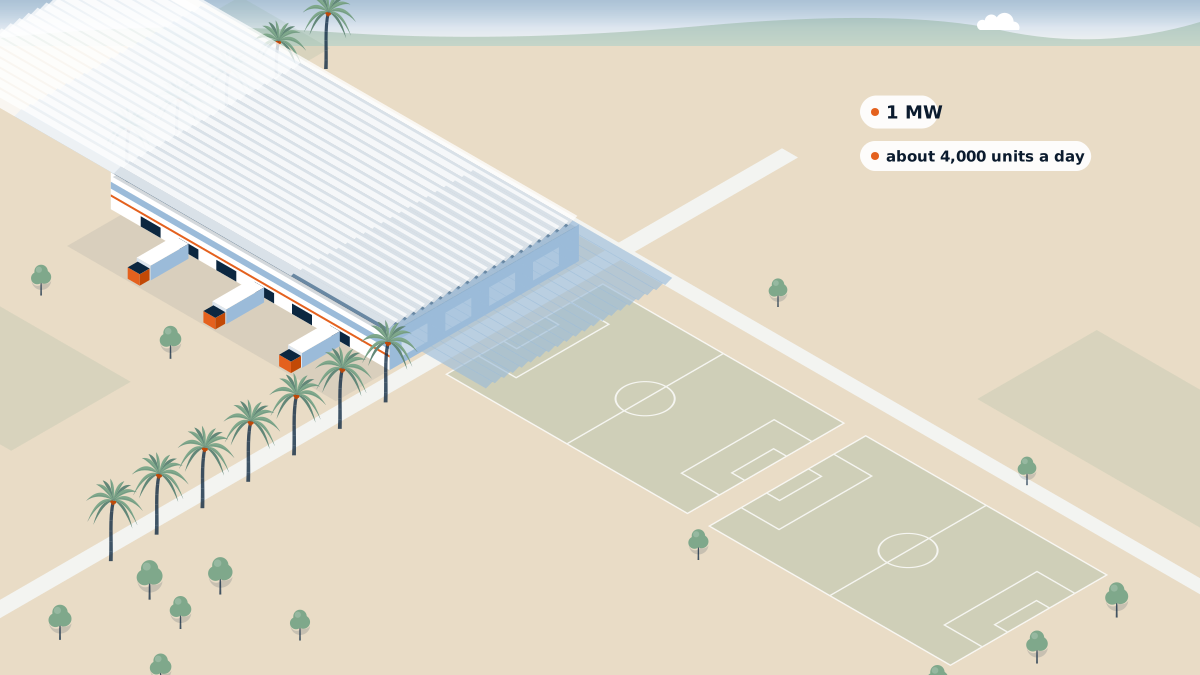
How many units does a 1 MW rooftop make?
- Per day, average
- 3,900–4,400 units
- Per month
- 1.2–1.33 lakh units
- Per year
- 14.4–16 lakh units
The basis is 1,440–1,600 units per kWp a year: 1,440 in our bill calculator, 1,500–1,600 on well-oriented factory roofs (our factory rooftop ROI guide). March to May run above average and the monsoon months below, and panels lose a little output every year.
What it saves at TNEB HT tariffs
- Energy charge
- ₹7.50
- Net value of a solar unit*
- ₹6.46
- Energy charge
- ₹9.40
- Net value of a solar unit*
- ₹8.36
Savings are before about ₹6 lakh a year of upkeep. Bars show the saving a year to scale; the lighter end is the top of the range.
*After the ₹1.04 network charge HT connections pay on each unit generated. Units made between 6 and 10 am also avoid the 25% peak-hour surcharge and are worth a little more. Solar does not cut the ₹608 per kVA demand charge (TNEB fixed and demand charges). All rates: TNEB commercial and industrial tariff.
Using the power versus exporting it
TNERC's GISS regulations count inverter (AC) capacity: a 1,000 kWp array on up to 999 kW of inverters, within contract demand, stays on net feed-in, where an exported unit earns ₹3.10 above 150 kW, less the network charge. Plants of 1 MW AC and above fall outside GISS and run in parallel operation. Either way, size the plant for the factory to use almost every unit on working days; exports pile up on Sundays and holidays. Solar on land, wheeled to your factory: ground-mount solar in Tamil Nadu. Selling to other consumers (open access or group captive): CAPEX vs RESCO vs open access and net metering for C&I in Tamil Nadu.
Is there a subsidy for 1 MW solar in Tamil Nadu?
No capital subsidy: PM Surya Ghar covers only homes and housing societies. A company that owns the plant can depreciate it at 40% a year on written-down value, plus 20% additional depreciation in year one for eligible manufacturers not on the 22% (section 115BAA) tax regime. If the plant runs under 180 days in its first year, only half of each rate is allowed that year; the other half of the 20% comes the next year. Details: accelerated depreciation on solar and commercial solar subsidy in Tamil Nadu.
Roof, load and connection checks
- Roof: about 90,000–100,000 sq ft (2–2.3 acres) of clear, shade-free roof, checked to IS 875 for dead load and wind uplift (wind load and roof safety).
- Load: daytime demand near 1 MW on working days.
- Connection: solar is capped at contract demand, so a 1 MW plant needs an HT connection at least that size.
Full list: 1 MW rooftop feasibility checklist.
Payback in one table
- Turnkey cost
- ₹3.8–4.2 crore₹38–42 a watt, before GST
- First-year saving
- ₹0.93–1.03 crorebefore about ₹6 lakh a year of upkeep
- Simple payback
- 3.7–4.5 yearsbefore upkeep; 3.9–4.8 years after it
- Plant life
- 25 years and more
Cost breakdown: what a 100 kW to 1 MW plant costs. Industry pages: solar for industries. Your own numbers: free savings report.
Frequently asked questions
How many units does 1 MW solar produce per day in Tamil Nadu?
About 3,900–4,400 units a day on average from a shade-free rooftop, or 14.4–16 lakh a year.
What is the monthly income from a 1 MW rooftop solar plant?
About ₹7.8–8.6 lakh a month in bill savings for an HT factory using the power on site, after the network charge. Exported units earn much less.
Is there a subsidy for 1 MW solar in Tamil Nadu?
No capital subsidy for commercial or industrial rooftops, but owners can claim 40% accelerated depreciation.
How much roof does a 1 MW plant need?
About 90,000–100,000 sq ft (2–2.3 acres) of clear, shade-free roof.
What is the payback of a 1 MW rooftop plant?
About 3.7–4.5 years for an HT factory before about ₹6 lakh a year of upkeep (3.9–4.8 years after it), shorter after accelerated depreciation.
Sources: TNERC Tariff Order No. 6 of 2025 (HT-I, HT-III, peak hours), TNERC GISS Regulations 2021. Checked 21 Nov 2026.