
Get a free site visitWhatsApp us
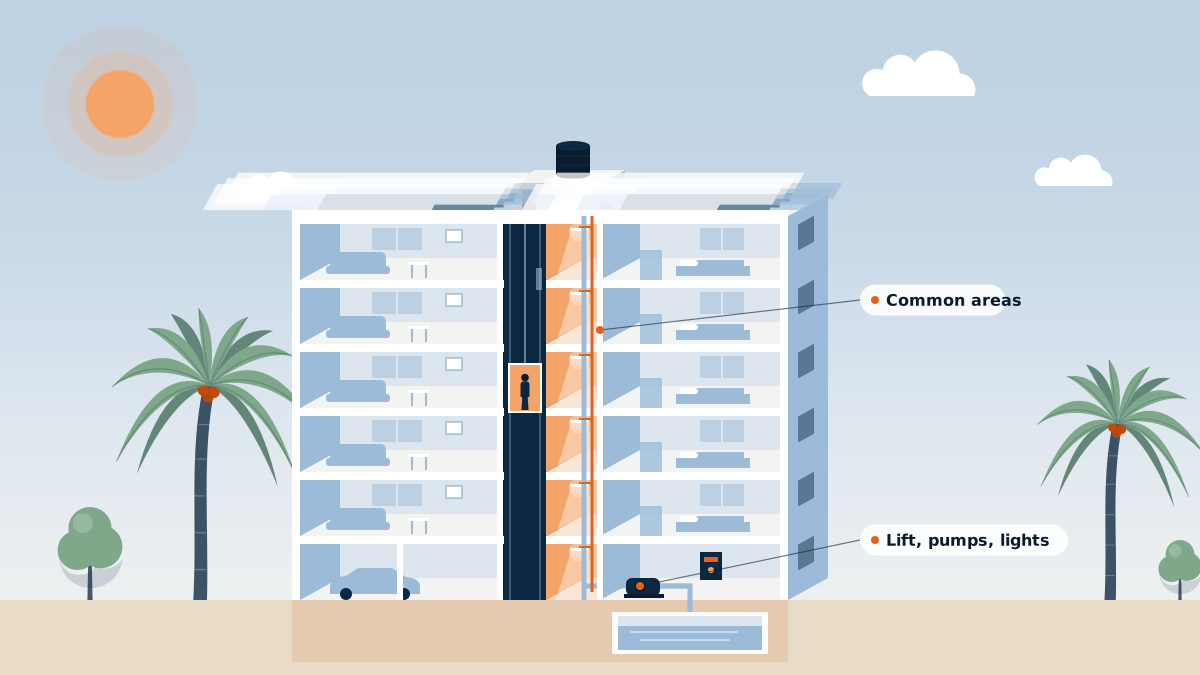
In most apartment blocks in Chennai and across Tamil Nadu, the largest electricity bill is the common supply for the lifts, water pumps, corridor and car-park lights, STP and gym. It pays a flat, commercial-style rate on every unit, so terrace solar saves more here than on a single home.
What apartment common areas pay for power in Tamil Nadu
- Fixed charge a month
- ₹110 a kW
- Fixed charge a month
- ₹110 a kW
- State support
- The state has paid part of it (₹2.80 a unit in FY 2024-25), so check your bill
- Fixed charge a month
- ₹608 per kVA
Bars show the energy charge per unit to scale.
A flat on LT I-A gets 200 units free a two-month bill if it uses 500 or fewer (100 if more), then pays slab rates. The common supply gets neither, so solar on the common meter usually pays back faster.
The RWA subsidy under PM Surya Ghar
PM Surya Ghar pays resident welfare associations and group housing societies ₹18,000 a kW for plants serving common facilities, EV charging included, up to 500 kW (up to 3 kW per house, counting any rooftop plants residents already have). Home-system rules apply: made-in-India (DCR) modules, a vendor registered for your DISCOM area, and an application on the national portal through TNPDCL. Home subsidy and how it is paid: PM Surya Ghar guide. Application screens: how to apply on the TNEB solar rooftop portal.
What a 30 kW plant costs and saves
Take a 60-flat block whose common supply uses 4,000–5,000 units a month. A 30 kW plant needs about 2,700–3,000 sq ft of shade-free terrace.
- Price before subsidy
- ₹15–18 lakh₹50,000–60,000 a kW, including GST
- Minus RWA subsidy
- ₹5.4 lakh30 kW × ₹18,000
- Price after subsidy
- ₹9.6–12.6 lakh
- Saving a year
- ≈₹3.1 lakhup to ₹3.8 lakh if TNPDCL waives the network charge; before about ₹18,000 a year of upkeep
- Payback
- 2.5–4 yearsroughly, before upkeep
- Solar units a month
- ≈3,600120 a kW
- Per flat
- ₹430–530 a monthoff the maintenance bill
Saving: ₹3.1 lakh a year if TNPDCL levies its ₹1.60 a unit network charge, ₹3.8 lakh if it waives it.
The saving assumes the common load uses solar units as they are made, or TNPDCL nets them; a unit exported under net feed-in earns ₹3.37. Screening numbers, not a quote. Bigger plants cost less per kW: rooftop solar price per kW.
How to size it
- Size from 12 months of common bills. Pumps and lifts run in daylight; corridor and car-park lights run at night on grid power.
- TNPDCL caps solar at the connection's sanctioned load, so a 25 kW common supply takes a 25 kW plant at most.
- Count clear terrace only, after the water tanks, lift room and their shadows. Elevated structures keep the space underneath usable.
- Surplus units are netted or paid a feed-in rate depending on the connection; TNPDCL confirms which at sanction.
Steps for the association
- Collect 12 months of common-supply bills and a rough terrace sketch.
- Get a site survey and a sized proposal showing the subsidy separately.
- Approve the plant and spend at a committee or general body meeting, as your bylaws require.
- Apply on pmsuryaghar.gov.in under the RWA / group housing category for the common-supply connection.
- Install with DCR modules; TNPDCL inspects and fits the meter.
- After inspection, the subsidy is paid into the association's bank account.
Check the portal’s document list when you apply; it can change.
Frequently asked questions
What tariff do apartment common areas pay in Tamil Nadu?
LT I-D: ₹8.80 a unit plus ₹110 a kW a month. Small blocks with no lift are on LT I-E, where the state has paid part of the charge.
Can an RWA get a solar subsidy in Tamil Nadu?
Yes. PM Surya Ghar pays RWAs and group housing societies ₹18,000 a kW for common-facility plants up to 500 kW.
How much terrace does a 30 kW apartment plant need?
About 2,700–3,000 sq ft of clear, shade-free terrace.
Does solar run the lifts and pumps at night?
No. Solar covers daytime load; night lighting comes from the grid.
How long does apartment solar take to pay back?
Roughly 2.5–4 years for an indicative 30 kW plant on an LT I-D supply, after the ₹18,000 a kW subsidy and before upkeep.
Sources: TNERC Tariff Order No. 6 of 2025 (pages 14–15 and 38–39, LT I-D and I-E; pages 18 and 27, cl. 3.1.3.2(i), HT-IIA), PM Surya Ghar national portal. Checked 21 Nov 2026.